John Guzlowski
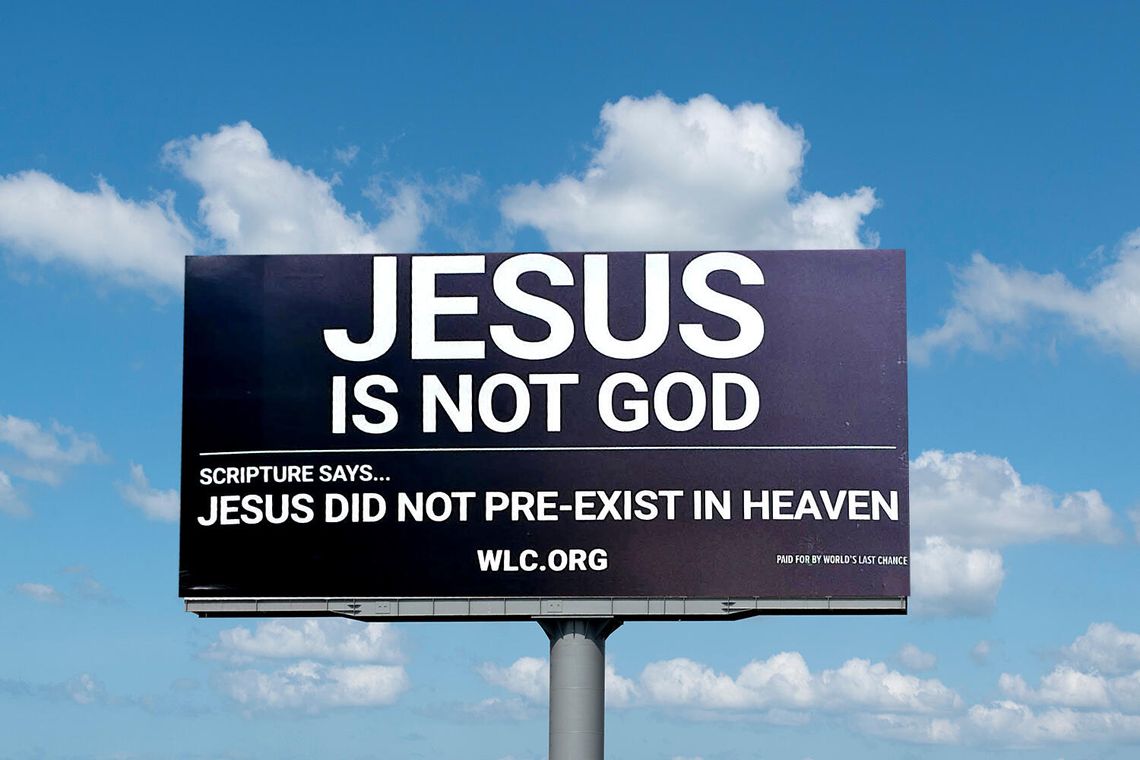
JEZUS NIE JEST BOGIEM!
To właśnie zobaczyłem na billboardzie, gdy jechałem z mojego domu w Lynchburgu w stanie Wirginia do Roanoke, żeby odwieźć siostrę mojej żony na lotnisko.
Billboard mnie zaszokował. Często przejeżdżałem tą drogą i często widywałem billboardy przy kościołach, ale te billboardy nie są szokujące ani prowokacyjne. Po prostu przedstawiają symbole takie jak krzyż, cytaty z Pisma Świętego lub przesłania religijne. Te przesłania zazwyczaj głoszą: „Jezus jest Miłością” i „Znajdź się w kościele w tę niedzielę”.
Kiedy pierwszy raz zobaczyłem ten billboard z napisem „Jezus nie jest Bogiem”, pomyślałem: „O kurcze, to billboard postawiony przez ateistów!”. Pomyślałem, że jacyś ludzie, którzy nie wierzą w Jezusa, Boga, Niebo i Biblię, wynajęli ten billboard, żeby zaatakować wszystkie billboardy na tej drodze, które głoszą tradycyjne wierzenia chrześcijańskie. Pomyślałem, że jakiś lokalny ateista chce zdenerwować ludzi i wywołać wojnę religijną.
Ciągle o tym myślałem przez całą drogę, jadąc do Roanoke i z powrotem do domu. Kiedy w końcu dotarłem do domu i usiadłem z laptopem, natychmiast wpisałem w Google pytanie: „Którzy chrześcijanie nie wierzą, że Jezus jest Bogiem?”.
Odpowiedź była równie szokująca, co stwierdzenie: „Jezus nie jest Bogiem”. Spędziłem 12 lat chodząc do szkół katolickich i wiele lat dłużej w kościołach katolickich, a zakonnice i księża zawsze uczyli mnie, że Jezus jest Bogiem. Jedną z pierwszych modlitw, które musiałem zapamiętać w szkole podstawowej, było Wyznanie Wiary Apostolskiej. Jego głównym przesłaniem jest to, że Jezus, Bóg i Duch Święty są – jak głosi Nicejskie Wyznanie Wiary – „jednym Bogiem”.
Dociekanie i moje badania nad tym, czy Jezus jest Bogiem, pokazały mi, że są chrześcijanie, którzy nie wierzą w Jezusa jako Boga. Liczba tych chrześcijan jest jednak niewielka. Badania pokazują, że na całym świecie około 2,6 miliarda ludzi to chrześcijanie. Z tej liczby około 2,2% uważa, że Jezus nie jest Bogiem. Istnieje kilka sekt poza głównym nurtem chrześcijaństwa, które najwyraźniej nie postrzegają Jezusa jako Boga. Do tych sekt należą Świadkowie Jehowy, mormoni, chrześcijanie unitariańscy i chrystadelfianie.
Kolejną szokującą rzeczą, którą odkryłem podczas badań, był rosnący odsetek chrześcijan, którzy nie wierzą, że Jezus był Bogiem. Według badania z 2020 roku, 52% wszystkich dorosłych Amerykanów zgadza się ze stwierdzeniem: „Jezus był wielkim nauczycielem, ale nie był Bogiem”. To samo badanie wykazało, że 30% ewangelikalnych chrześcijan podziela podobne przekonanie.
Wszystkie te wyniki moich badań były zaskakujące, ale chyba najbardziej szokujące było to, czego dowiedziałem się o billboardzie, który skłonił mnie do rozpoczęcia tych dociekań. Billboard, który zobaczyłem, nie był jedynym billboardem w Ameryce, który głosił, że „Jezus nie był Bogiem”. Najwyraźniej billboard z napisem „Jezus nie jest Bogiem” pojawił się nie tylko w kilku miastach Wirginii, ale także w Kalifornii, Missisipi, Teksasie i Alabamie.
Okazuje się, że billboard jest dziełem „World’s Last Chance”(Ostatniej Szansy Świata). To sekta apokaliptyczna, działająca głównie w internecie, posiadająca stronę internetową i rozległą obecność na Facebooku, z około 800 tysiącami obserwujących. Ta organizacja ma nadzieję przekonać ludzi, by zapomnieli o wyznaniach chrześcijańskich, do których należą, i dołączyli do Ostatniej Szansy Świata, aby przygotować się na koniec świata i ostateczne przyjście Jezusa.
Jeśli masz wątpliwości, dołącz do klubu. Miałem nadzieję uporządkować wszystkie te informacje o tym, kto wierzy, że Jezus jest Bogiem, a kto nie, ale najwyraźniej popadałem w coraz większe zamęt. A ten zamęt jeszcze się pogłębił, gdy odkryłem, że billboardy są finansowane przez egipskiego biznesmena, który zarabia na kosmetykach!
Ale tak naprawdę nie powinienem być zaskoczony religiami i przekonaniami religijnymi. Od czasów szkół katolickich spędziłem dużo czasu na rozmyślaniu i zgłębianiu religii oraz prawd, które one oferują. Czytałem o Kościele katolickim i około 45 tys. wyznań chrześcijańskich. Przyjrzałem się również hinduizmowi, buddyzmowi, judaizmowi i islamowi. To wszystko uświadomiło mi, że nasze ludzkie pragnienie znalezienia prawdziwego wyjaśnienia tego, kim jest Bóg i czego od nas oczekuje, jest niezwykle skomplikowane. Wydaje się, że nie ma łatwych, prostych odpowiedzi.
Chyba będę musiał poczekać, aż znajdę się w niebie, aby dowiedzieć się, czy większość chrześcijan ma rację, czy się myli, co do tego, czy Jezus jest Bogiem.
God only Knows
JESUS IS NOT GOD!
That’s what I saw on a billboard while driving from my home in Lynchburg, Virginia, to Roanoke to take my wife’s sister to the airport.
The billboard absolutely shocked me. I’ve often driven along this road, and a lot of times there are billboards put up by churches, but these billboards aren’t shocking or provocative. They just feature symbols like the cross, scriptural quotations, or religious messages. These messages usually say things like “Jesus is Love” and “Find Yourself in Church This Sunday.”
When I first saw this billboard that said “Jesus is not God,” I thought, “Holy Smokes, this is a billboard put up by atheists!” I figured some folks who didn’t believe in Jesus, God, Heaven, and the Bible had rented this billboard to attack all the billboards on this road advocating traditional Christian beliefs. I figured some local atheist was looking to annoy people and get a religious war going.
I kept thinking about this as I drove all the way to Roanoke and all the way back home. When I finally got home and sat down with my laptop, I immediately googled the question, “What Christians don’t believe Jesus is God.”
The answer was as shocking as the statement “Jesus is not God.” I had spent 12 years going to a Catholic schools and many years more than that going to Catholic Churches, and what the nuns and the priests always taught me was that Jesus was God. One of the first prayers I had to memorize in grammar school was the Apostle’s Creed. The main point it makes is that Jesus, God, and the Holy Spirit are all – just as the Nicene Creed says – “one God.”
What researching whether Jesus is God showed me was that there are Christians who do not believe Jesus is God. The number of these Christians is, however, quite small. Studies show that worldwide about 2.6 billion people are Christian. Of this number, about 2.2% believe Jesus is not God. There are several sects outside of the Christian mainstream that don’t apparently see Jesus as God. These sects are the Jehovah’s Witnesses, the Mormons, the Unitarian Christians, and the Christadelphians.
Another shocking thing I found while researching was that the number of Christians who don’t believe Jesus was God is on the rise. According to a 2020 survey, 52% of all American adults agree with the statement “Jesus was a great teacher, but he was not God.” The same survey found that 30% of Evangelical Christians hold a similar belief.
All of these results of my research were surprising, but perhaps what was most shocking was what I found out about the billboard that got me started on this research. The billboard I saw was not the only billboard in America that was advocating that “Jesus was not God.” Apparently, the “Jesus is not God” billboard has appeared not only in a number of cities in Virginia, but also in California, Mississippi, Texas, and Alabama.
It turns out the billboard is the product of “World’s Last Chance.” It’s a doomsday cult that is primarily an online ministry with a website and extensive presence on Facebook with about 800,000 followers. This ministry is hoping to persuade people to forget the Christian denominations they follow and join World’s Last Chance in order to prepare for the end of the world and the final coming of Jesus.
If you’re confused, join the club. I was hoping to sort out all this information about who believes that Jesus is God and who doesn’t believe that Jesus is God, but I seem to have walked into more and more confusion. And that confusion was boosted considerably when I discovered that the billboards are funded by an Egyptian businessman who makes his money off cosmetics!
But really I shouldn’t be surprised about religions and religious beliefs. Since my days in Catholic schools, I’ve spent a lot of time thinking about and studying religions and the truths they offer. I’ve read about the Catholic Church and the estimated 45,000 Christian denominations. I’ve also looked at Hinduism, Buddhism, Judaism, and Islam. What all of this has told me is that our human desire to find the real explanation of who God is and what he wants us to do is incredibly complicated. There don’t appear to be any easy, simple answers.
I guess I’ll just have to wait until I get to heaven to find out if most Christians are right or wrong about whether Jesus is God.
John Guzlowski
.JPG)
amerykański pisarz i poeta polskiego pochodzenia. Publikował w wielu pismach literackich, zarówno w USA, jak i za granicą, m.in. w „Writer’s Almanac”, „Akcent”, „Ontario Review” i „North American Review”. Jego wiersze i eseje opisujące przeżycia jego rodziców – robotników przymusowych w nazistowskich Niemczech oraz uchodźców wojennych, którzy emigrowali do Chicago – ukazały się we wspomnieniowym tomie pt. „Echoes of Tattered Tongues”. W 2017 roku książka ta zdobyła nagrodę poetycką im. Benjamina Franklina oraz nagrodę literacką Erica Hoffera za najbardziej prowokującą do myślenia książkę roku. Jest również autorem serii powieści kryminalnych o Hanku i Marvinie, których akcja toczy się w Chicago oraz powieści wojennej pt. „Retreat— A Love Story”. John Guzlowski jest emerytowanym profesorem Eastern Illinois University.
-
John Guzlowski's writing has been featured in Garrison Keillor’s Writer’s Almanac, Akcent, Ontario Review, North American Review, and other journals here and abroad. His poems and personal essays about his Polish parents’ experiences as slave laborers in Nazi Germany and refugees in Chicago appear in his memoir Echoes of Tattered Tongues. Echoes received the 2017 Benjamin Franklin Poetry Award and the Eric Hoffer Foundation's Montaigne Award for most thought-provoking book of the year. He is also the author of two Hank Purcell mysteries and the war novel Road of Bones. Guzlowski is a Professor Emeritus at Eastern Illinois University.